

Everything is red. So let’s see what the companies actually did.
Small caps are suffering. The Russell 2000 closed Friday at 2,721, about 11% below its August 12 record. The Nasdaq lost 4.5% last week, its worst week since June.
The drivers are rates, the mid-term elections and the AI trade. September CPI came in at 3.7% against 3.6% expected, and the 10-year sat above 5% for much of the month. Chip stocks were on track to fall more than 14% in seven sessions.
The damage is wider than the indexes show. As of October 1, 43% of S&P 500 companies were 20% or more below their 52-week highs, and 38% of the TSX. Small caps have taken the worst of it.
So this update separates price from progress. Most of the charts below look bad or flat. For each one I want to know: did the business move forward, stand still, or slip?
(Nasdaq: ADUR · TSX: ACT)
Aduro closed Friday at US$9.95, 45% below its June high, with C$65.8 million in the bank.
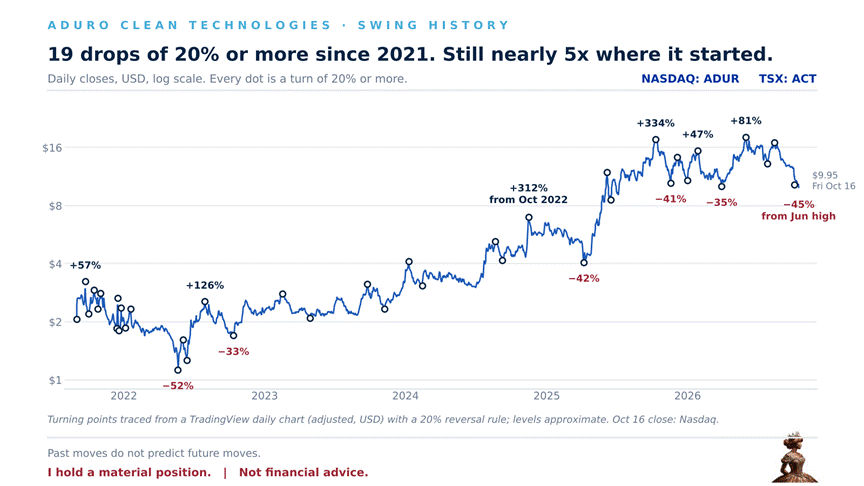
This is the chart I want every new Aduro holder to see. Since 2021 the stock has had 19 drops of 20% or more. The five biggest:
• Jan to May 2022: −52%
• Nov 2024 to Apr 2025: −42%
• Oct to Nov 2025: −41%
• Jan to Mar 2026: −35%
• Jun to Oct 2026: −45%, and counting
It is still nearly 5x its starting price. That’s the honest framing: this stock has never moved in a straight line. This is the burden )or opportunity) of high Beta stocks. They move much more than your standard S&P stocks.
Three times since November 2025, the stock found buyers between $10 and $11. Shorts have been playing the same game every session, the market opens, they sell into the bid and try to cause panic. Between that, mid-term nerve and general global volatility, Friday closed just under that $10 zone. For reference the 52-week low is US$9.00 and the June offering was priced at US$15.20.
What the business did:
• Cash: C$65.8 million at August 31, up from C$38.3 million in May after the June raise. Operating cash burn was C$2.6 million for the quarter. Not bad for a ‘pre-revenue’ company.
• First commercial plant (FOAK): a 10,000 ton-per-year plant at Chemelot in the Netherlands. Saipem was selected on August 19 for Early Works, which refines the design and the capital cost estimate. Completion is expected in early 2028. Capital cost and the full engineering phase (FEED) haven’t been announced.
• Paraffinic crude: Uinta Basin crude supply secured in July, a continuous-flow lab unit completed, and the London, Ontario facility expanded. Aduro presented the program in Houston this month. No commercial terms or test numbers are public yet.
• Pilot plant: a 75-hour campaign in September processed about 758 kg, with liquid yields of 88.8–90.8% across three feed blends.
What I’m watching: Saipem’s Early Works turning into a FEED decision, and the first continuous-flow data on paraffinic crude.

(CSE: AIDR · OTC: AIRDF)
Rocket Doctor completed 6,101 U.S. visits in Q3, up 56% on the quarter and 12% ahead of its own estimate. The stock is 47% below its October 2025 high.
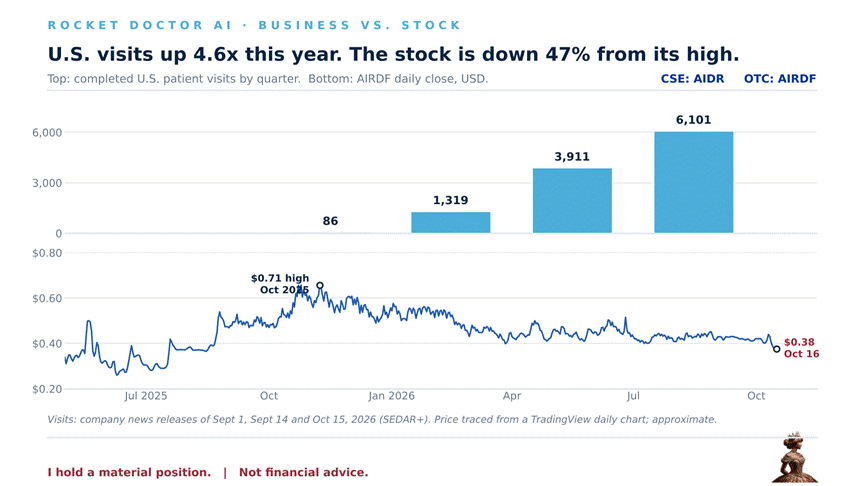
This is the clearest gap in the portfolio between what a business is doing and what its stock is doing. U.S. visits went from 1,319 in Q1 to 6,101 in Q3, a 4.6x increase in two quarters. AIRDF went from about $0.49 to $0.38 over the same stretch.
The Q3 numbers (released October 15):
• U.S. completed visits: 6,101, versus the company’s September estimate of 5,438
• U.S. clinical hours: 2,634, up 33% on Q2
• Canadian visits: 47,247, up 24% on Q3 2025
• Total visits: 53,348
• More than 20 in-network payer agreements across commercial, Medicare Advantage and Medicaid
No Q3 revenue figure yet. The company says it expects record quarterly revenue. U.S. revenue is booked when cash arrives, so it lags visits by design.

(CSE: AIOS)
Algo8 began trading on the CSE as AIOS around October 13, after being spun out of GoGo AI. My full deep dive goes up this week, so here are just the basics:
Shareholders of GOGO AI own the only free-trading shares of Algo8. About 32% of the company. I received my shares on Friday and I know a few other people have not received them yet.
• What it does: industrial AI. Its PlantBrain system handles scheduling, maintenance, quality and energy use in steel, tire, automotive and energy plants. It has more than 80 deployments.
• Backers: Chemelex, a Brookfield subsidiary, invested C$2.79 million before the listing (at an equivalent of $0.93 CAD).
• Locked-up shares: about 66% of the shares are escrowed or locked up, mostly on a release schedule from 12 to 36 months.

Panthera Resources
(AIM: PAT | US OTC: PATRF)
Panthera climbed from about 19p in late July to 26p in late September, and sits at 23p. That’s well above the 17.5p September placing, and the biggest catalyst is still eight weeks away. Expect a full report from me this week.
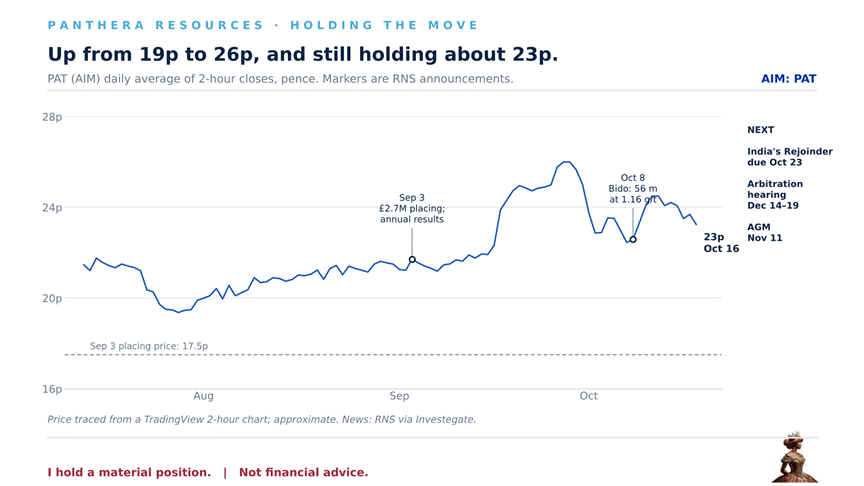
The arbitration against India. Panthera’s subsidiary Indo Gold is claiming US$1.58 billion from the Republic of India under the Australia–India investment treaty. The calendar:
• October 23: India’s Rejoinder is due.
• December 14–19: hearing at the Peace Palace in The Hague.
• January 11, 2027: oral closings.
The case is funded by a US$13.6 million non-recourse facility from Litigation Capital Management. US$9.68 million had been drawn by March 31.
The gold. On October 8 Panthera reported drilling at Bido in Burkina Faso, which it owns 80%. Its best hole cut 56 meters at 1.16 g/t gold, including 28 meters at 2.04 g/t. The company’s exploration target is 0.7–1.6 million ounces. That target is conceptual, not a resource. Infill drilling comes next.
The money. Panthera raised about £2.7 million at 17.5p on September 3, a 16.7% discount to the prior close. Cash at March 31, before that raise, was US$2.09 million.
The AGM is November 11.
What I’m watching: the December hearing. Arbitration outcomes are binary and slow, and collecting an award from a sovereign state is its own process.


(CSE: BPC · OTCQB: PNGAF)
CEO Pratap Sandhu moved two products forward in the past two weeks: a 20,000-unit order of Thymosin Alpha-1 patches and U.S. testing of a tirzepatide (GLP-1) patch. The stock has drifted from about C$0.48 in July to the low C$0.30s.
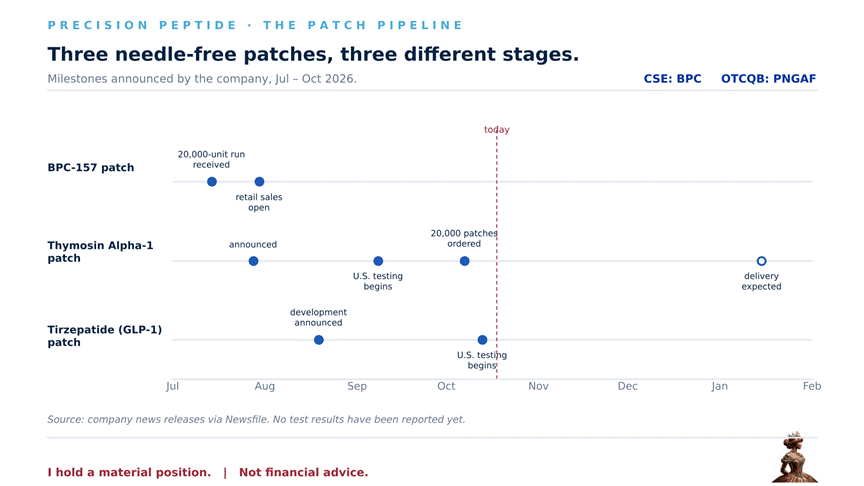
The recent releases:
• Oct 13: the needle-free tirzepatide patch entered formal U.S. testing. No testing partner or results date was given.
• Oct 7: first commercial order of 20,000 Thymosin Alpha-1 patches, expected in January 2027.
• Sep 29: a U.S. wholesale channel opened for its non-prescription patches and supplements, aimed at clinics, med spas and gyms.
• Sep 8: the Thymosin Alpha-1 patch entered U.S. testing, targeted to finish in Q3/Q4.
One piece of background matters here. In July, an FDA advisory committee voted 8–6 to recommend BPC-157 for the list of substances pharmacies can compound. That vote is non-binding.
What readers should know:
• Regulation is the open question. How regulators treat these products is the biggest issue for me, and nothing this month settled it. “Testing” is not approval, and no results have been reported.
What I’m watching: test results on either patch, and any regulatory guidance on peptides.

(TSXV: SPMC · OTCQB: SPMEF)
SPMC went from C$0.365 in late June to C$0.90 in early September, raised C$20 million, and closed Friday at C$0.73. In this market, that counts as holding well.
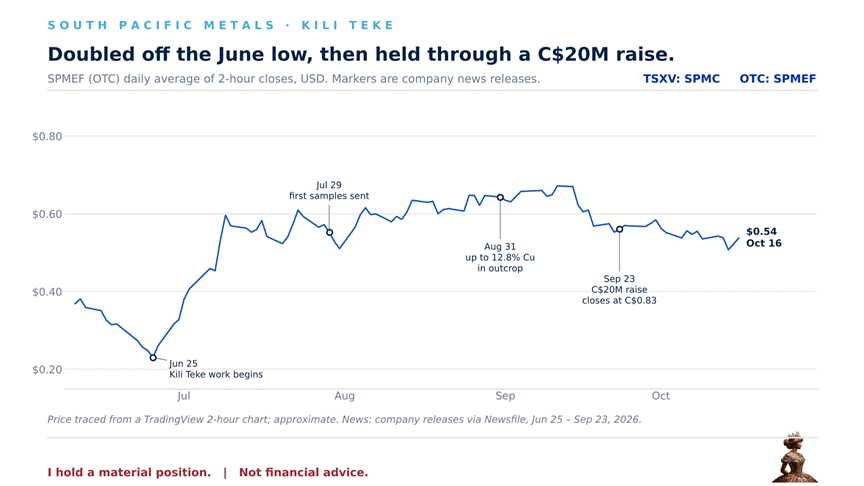
The story is Kili Teke, a copper-gold porphyry in Papua New Guinea that SPMC owns 100%. It comes with an inferred resource of 237 million tons at 0.34% copper and 0.24 g/t gold, from 2022. That resource covers only the central porphyry. Harmony Gold spent more than US$20 million drilling it before SPMC.
What happened since June:
• Jun 25: field work started at Kili Teke.
• Aug 31: massive sulphide in outcrop, mapped over 200 meters and still open, outside the resource. The best sample assayed 12.8% copper. 205 soil and 60 rock samples were still pending.
• Sep 23: closed a C$20.0 million offering led by BMO: units at C$0.83, each with a warrant at C$1.40 for two years.
The company has guided to drill-ready targets by the end of October, with a first drill program in the second half of 2026. Copper is near record highs at about US$6.53/lb.
Two things readers should know:
• The stock is below the placement price. C$0.73 is 12% under C$0.83, and those 24.1 million units come free to trade on January 24, 2027.
What I’m watching: the pending assays and the drill targets due this month.

(TSXV: LIB · OTCQB: VLTLF)
LibertyStream has stacked four financings and a loan term sheet in ten months. At Friday’s C$0.71, every recent warrant is out of the money. But I’ve never been more bullish.
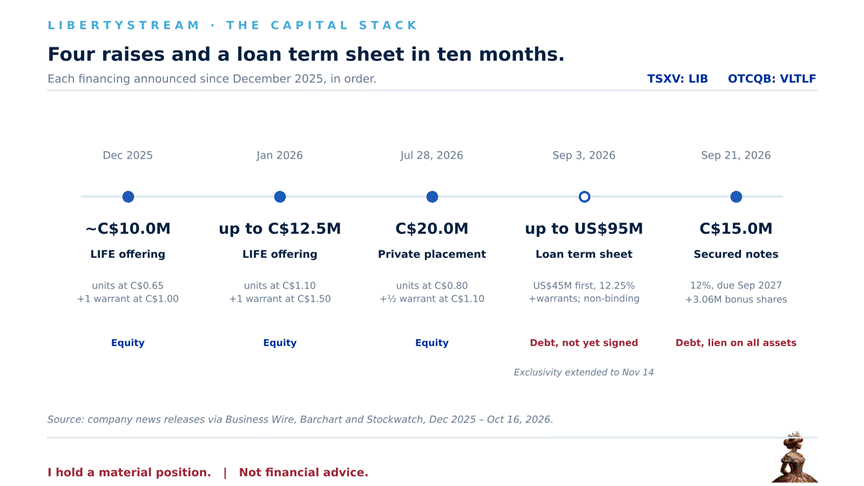
There isn’t one complicated deal here. It’s the stack that’s complicated.
Think of it as building a house:
• Savings: the equity raises.
• A 12% bridge loan secured against everything you own: the Pathfinder notes.
• A construction loan offer: not signed yet, and it wants you to put in more of your own money first.
The pieces:
1. Equity, about C$42.5 million since December. The latest was 25 million units at C$0.80 in July, each with half a warrant at C$1.10. Insiders, including the CEO, bought C$2.2 million of it.
2. Pathfinder secured notes, C$15 million (September 21). 12% interest, all due September 21, 2027. The lender also gets 3.06 million bonus shares, worth 20% of the loan. The notes are secured against all of the company’s present and future assets.
3. Endurance term sheet, up to US$95 million (September 3). It starts with a US$45 million senior secured construction loan at 12.25%. Money is released as construction milestones are certified. Endurance also gets warrants described as “up to 10%” of that first loan. Count and price aren’t set yet.
It’s non-binding. One condition is that LibertyStream makes its own “investment commitment” first, and the amount hasn’t been disclosed. On October 16, exclusivity was extended to November 14.
What the money builds: Freedom 1, a plant designed for about 1,000 tonnes a year of lithium carbonate, with first commercial deliveries targeted for Q2 2027. There’s a definitive offtake for 600 tonnes a year with an unnamed U.S. buyer. The demonstration site has produced about 3 tonnes at 99.7%+ purity.
It’s not just Lithium
What I’m watching:
• Endurance: whether the loan signs by November 14, and how big the required investment commitment is.
• Two secured lenders: how they rank against each other. Both are described as senior and secured, and how that gets resolved hasn’t been disclosed.
• The November meeting: it was postponed to the second half of November, tied to a planned U.S. listing. Watch the circular for a share consolidation.
• The U.S. IPO: a draft S-1 is with the SEC, which means more equity is coming.
• Unlocks: the July placement shares come free to trade in late November.

(CSE: LEEF · OTCQB: LEEEF)
LEEF’s Q2 revenue fell 16% to US$7.27 million on a gap in biomass supply between harvests. Gross margin nearly doubled, to 33.1% from 17.1% the year prior. I think the lower quarter actually proves the point of their model.
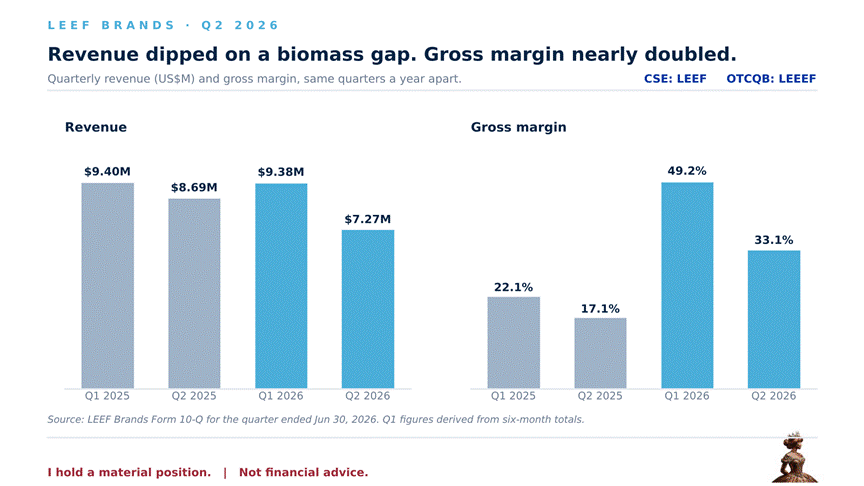
“Trucking along” is about right. The story at LEEF is margin. Management says quarters running on its own ranch biomass have hit about 50% gross margin. Through six months:
• Gross margin is 42.2% against 19.7% a year ago.
• The net loss narrowed to US$1.76 million.
• Company-defined adjusted EBITDA was positive US$1.71 million.
Operations:
• Salisbury Canyon Ranch: the largest harvest yet, nearly 1 million plants on about 80 acres. The plan is about 122 acres this fall and the full 180 permitted acres in 2027.
• Himalaya brand: acquired in April. It added about US$1.0 million of revenue in its partial first quarter.
• Financing: US$5.2 million of preferred shares closed in July, about US$14.5 million across all closings. The money is meant to buy a processing facility, and that purchase hasn’t been announced yet.
The fine print: the 10-Q carries going-concern language. Notes payable are about US$10.6 million, and stockholders’ equity is a deficit of US$2.04 million. One customer was 14.8% of first-half revenue.
What I’m watching: Q3 (July to September), and whether margins hold as the new harvest comes through.

(CSE: GOAT · OTCQB: BGTTF)
GOAT is in a standstill. The company hasn’t issued a news release since May 19. But they are now trading again. It will be great to hear what the business was up to during the halt.
Disclosures
I hold long positions in all of these companies. I am not an investment advisor, and this is not investment advice. Investment is risky, consult a professional and for heaven’s sake, do your own due diligence.
The drawdown-history framing is the honest way to hold a name like this. On Aduro, with FEED and the full capital cost still unannounced against C$65.8 million in the bank, do you see the cash carrying them to early 2028 commissioning, or is another raise likely before then?
Any updates on CISO?